
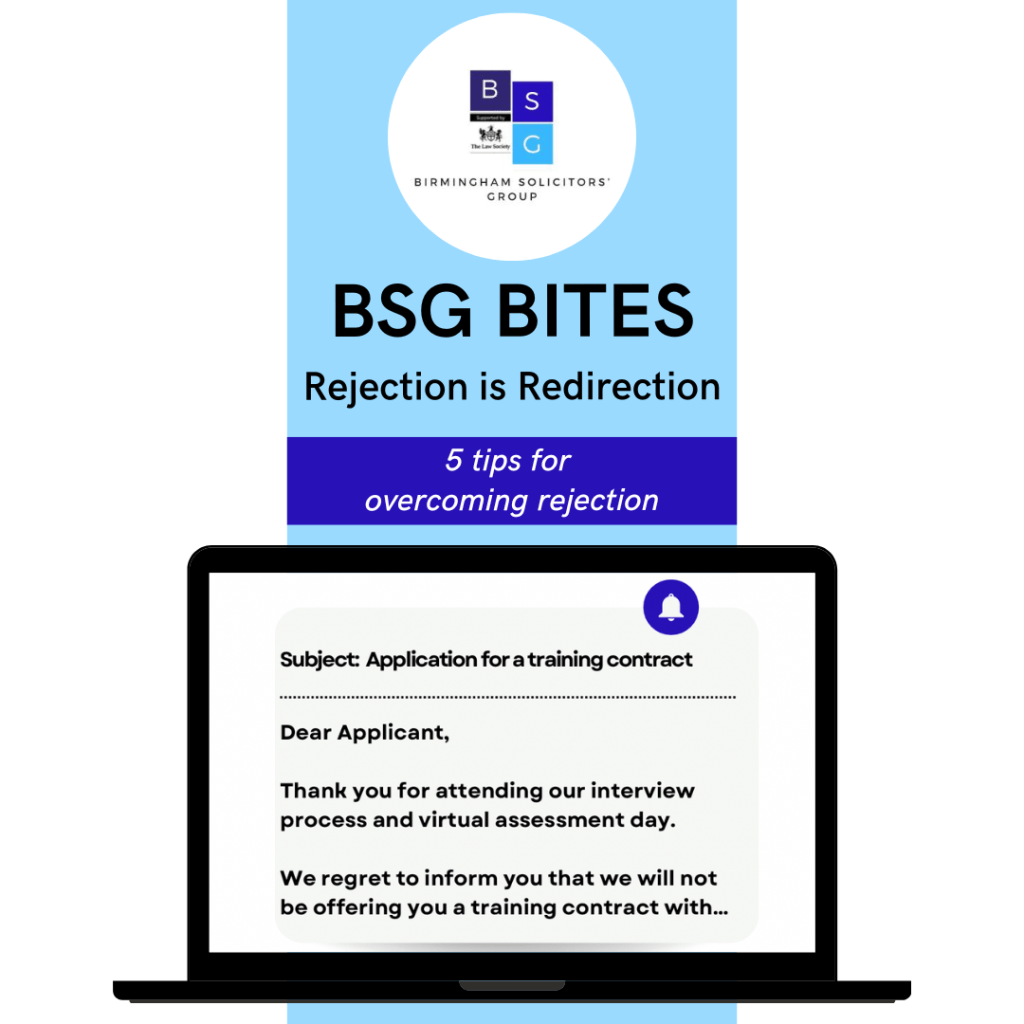
Rejection is Redirection
The dreaded email…
“Dear Nicky,
Thank you for attending our interview process and virtual assessment day.
We regret to inform you that we will not be offering you a training contract with….”
The above is an example of one of many rejection emails I received when I was trying to secure a training contract. I know all too well the disheartening feeling when you open that email from the graduate recruitment team and see the words in red.
I often receive messages on LinkedIn asking for advice and tips on application forms and assessment centres. Unfortunately, this comes with subsequent messages of many informing me that they had been unsuccessful in the process. This encouraged me to write this article on how to bounce back from training contract rejection.
In any context, rejection is a sore hit but the tips below helped me and I hope they can help you too.
- Practice makes perfect
Treat the experience (whether that be submitting a lengthy application form, taking part in a group exercise or completing a video interview) as a learning curve. Now you know what it looks like, you can only get better at it.
For me, my first video interview was extremely daunting but once I experienced it, I was able to anticipate what it would be like the next time around, which put me in good stead.
All it takes is that one ‘yes’ and for every no, I would treat it as a practice run until you get the ‘right one.’
- Can you see yourself at the firm?
The above leads me on to the next point – look at the rejection as redirecting you to the right place.
Looking back at my training contract journey, I can understand why I was rejected by some of the law firms I had applied for. As cliché as it sounds, you need to be the right fit for the firm and the firm needs to be the right fit for you.
What helped me was narrowing down the firms I was applying for. To do this, I focused on key aspects that were important to me, for example, the firm’s key practice areas, the culture, the training contract structure and the opportunities for development. Therefore, I would recommend really honing in on where you are focusing your energy and tailor your applications accordingly.
There is no point applying for a firm that you have no interest in because it will only show during the process. If you are unsure on which firms to apply for, I would recommend reviewing online resources such as LawCarees.Net and Chambers Student as a starting point. I would also recommend attending any firm-specific events such as insight evenings. I found the open evenings particularly useful as I was able to speak to the current trainees and gain a better insight into the culture of the firm.
Many law firms now have a huge presence across different social media platforms such as LinkedIn and Instagram. I would recommend following law firms on social media and keeping up to date with their articles and following the deals that they are currently working on.
- Can you request feedback?
I would definitely recommend obtaining feedback where you can. This was particularly useful for me as I was able to understand my weaknesses and focus on strengthening them. I did this by picking out the weakness and creating an action plan of how I would address it. For example, if your weakness is commercial awareness, are there any news updates that you can sign up to? Are there any events that you can attend to help increase your commercial awareness?
I know law firms do not always offer feedback, particularly during the early stages of the process. In this case, I would recommend reviewing your application form with a fine toothcomb and picking out any areas where you think you could improve. Are there any spelling mistakes? Is there a better example you could have used? Is your answer tailored enough to the law firm? Are your answers too generic? Have you related your experience back to the question?
- Avoid comparisons – “why have they got a training contract offer but I haven’t?”
I know how easy it is, especially with social media, to compare yourself to others. However, everyone is on their own journey.
When self-doubt creeps in, try and focus on yourself and remind yourself of your own goals and aspirations.
If it takes you that bit longer to secure the training contract, it will only feel that much more rewarding when you receive that ‘yes.’
Be proud of yourself for how far you have come. I am a strong believer that patience and perseverance are key ingredients for success and by continuing to work on yourself, it will only pay off in the end.
It took me three years after I graduated to secure a training contract. Did I think it would take that long? No, not at all, but looking back, I am so grateful for the experiences I had as a paralegal as it made the transition to trainee a lot smoother.
- Use your support network
Following on from the above, I think it is important to surround yourself with a supportive network to help uplift you during any period of rejection.
Attending networking events can help to engage in conversations and learn hints and tips from others. If you are based in or around Birmingham, I would recommend signing up to the junior networking groups such as Birmingham Solicitors Group. This provides for the opportunity to speak with other junior legal professionals who are, or have been, in the same boat.
Overall, rejection is a hard pill to swallow but we all have to face it at some point in life and throughout our legal careers. Take the time to process the rejection, create an action plan for the next application cycle, network where you can and follow up on those conversations on LinkedIn.
By Nicky Tattal, Junior Representative of Birmingham Solicitors’ Group and Trainee Solicitor at Irwin Mitchell.
 Birmingham Solicitors' Group